

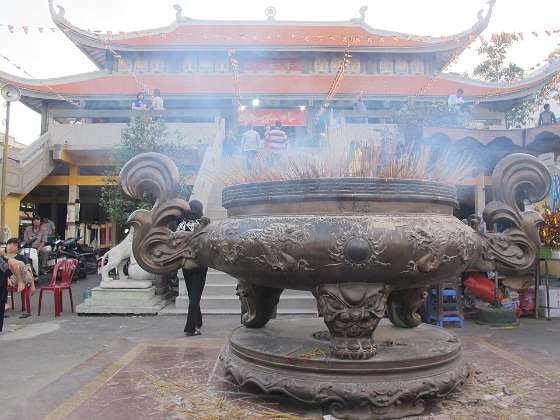
A pagoda in classic Northern Vietnamese style in the former District 3, with a seven-storey Quan The Am stupa nearly 40 m tall
Vinh Nghiem Pagoda is one of the most famous pagodas in Vietnam and a landmark of 20th-century Vietnamese Buddhist architecture. It was built by two Most Venerable monks, Thich Tam Giac and Thich Thanh Kiem, who came from the North to spread Buddhism in the South, and was modelled on the wooden pagoda of the same name in Duc La commune, Bac Giang province — a pagoda founded under King Ly Thai To that was once the centre of the Truc Lam Zen school. The design was drawn by architect Nguyen Ba Lang, together with Le Tan Chuyen and Co Van Hau. Construction began in 1964 on low-lying land beside the Thi Nghe canal; around 40,000 m³ of earth had to be trucked in from the Bien Hoa highway to level the site, at a cost of about 98 million dong at the time, funded entirely by Buddhist followers. The pagoda was essentially completed in 1971. Its architecture follows the classic Northern style but was built with modern techniques and materials, on grounds of about 6,000 m². The old-style three-entrance gate bears parallel sentences written in the Vietnamese Latin script: "Arriving at the gate of compassion, paying homage to the ancestral temple of the North / Entering the pagoda of liberation, spreading the Dharma in the South." Facing the gate is a statue of Avalokitesvara Bodhisattva (Quan The Am). Three wide staircases, each with 23 steps, lead up to the terrace, where there is a statue of the holy monk Sivali on his alms round and a bell tower holding the great "Peace Bell", 1.8 m in diameter, cast in 1971 and donated by Entsu-in Temple (Vien Thong vien) in Fukushima, Japan. The Buddha hall is built on an I-shaped (chu cong) plan, with curved roof corners in the Northern pagoda style and a Dharma wheel on the ridge. The worship hall is 35 m long, 22 m wide and 15 m high; at its centre is Shakyamuni Buddha, flanked by the Bodhisattvas Manjusri (Van Thu) and Samantabhadra (Pho Hien). Paintings of Arhats line the walls; there are carved wooden canopies featuring the four sacred animals and nine dragons, and the reliefs on the altar table depict famous pagodas in Vietnam and across Asia. To the left of the Buddha hall stands the seven-storey Quan The Am Stupa, nearly 40 m tall with a square base 6 m on each side, built at the same time as the pagoda and among the most massive Buddhist stupas in Vietnam. Just past the gate, on the right, is the 14 m Vinh Nghiem Stone Stupa, inaugurated in December 2003 and dedicated to the Most Venerable Thich Thanh Kiem; as of 2013, it was considered the first stone stupa in the South and the largest and tallest stone stupa in Vietnam. The pagoda is busiest on the 1st and 15th day of each lunar month, during Tet (Lunar New Year), the first full moon of the lunar year, Vesak (the Buddha's Birthday) and Vu Lan. The 8th day of the 12th lunar month marks the Buddha's Enlightenment and the death anniversary of the Vinh Nghiem patriarch.
English text: machine translation from the Localis platform — proper names kept in Vietnamese.Good to know
Best time to visitYear-round; liveliest on the 1st and 15th of the lunar month and during the Vesak and Vu Lan seasons
Services
- See the I-shaped Buddha hall and the wooden canopies carved with the four sacred animals and nine dragons
- Admire the seven-storey Quan The Am Stupa, nearly 40 m tall
- See the Peace Bell donated by Entsu-in Temple (Japan)
- Look for the Vietnamese-script parallel sentences on the three-entrance gate
- Attend ceremonies on the 1st or 15th of the lunar month, or the patriarch's anniversary on the 8th day of the 12th lunar month


















 Localis