



A fortified prison camp built 1908 – 1916 in central Con Dao, linked to generations of political prisoners and a Tet play staged in 1935
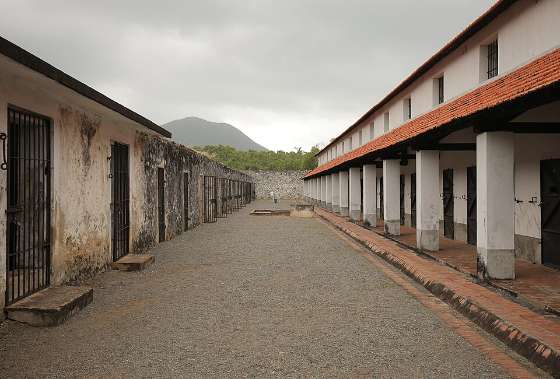
Located at the corner of Ton Duc Thang and Nguyen An Ninh streets, Phu Son Camp is the second-oldest camp of the Con Dao prison system, after Phu Hai Camp. Its first name was Banh II, later Lao 2, Nhan Vi Camp, Camp 3, and from 1973 onwards Phu Son Camp. The site belongs to the Con Dao Prison Special National Relic, recognised by the Prime Minister on 10 May 2012. The camp was built by the French from 1908 to 1916, covering 13,228 m², with 13 large cells and 14 solitary cells, enclosed by high stone walls; the imposing, solidly built complex has an elevated walkway running along the rows of cells. It bears the mark of many generations of political prisoners, such as Le Duan, Pham Van Dong, Le Hong Phong, Nguyen Van Linh and Hoang Quoc Viet. At Tet in 1935, the prisoners staged the play Napoleon right in the camp courtyard. The group of tropical almond trees in the camp is among the 79 ancient trees of Con Dao recognised as Vietnam Heritage Trees in 2012. Phu Son Camp is next to Phu Hai Camp, only about a 5-minute walk from Pier 914 and the Governor's Palace, and is on the relic site's official visiting route.
English text: machine translation from the Localis platform — proper names kept in Vietnamese.Good to know
Best time to visitYear-round; mornings are best
Services
- Visit the camp on the relic site's official route
- Admire the ancient tropical almond trees – Vietnam Heritage Trees
- Walk on to Phu Hai Camp and Pier 914
















 Localis