

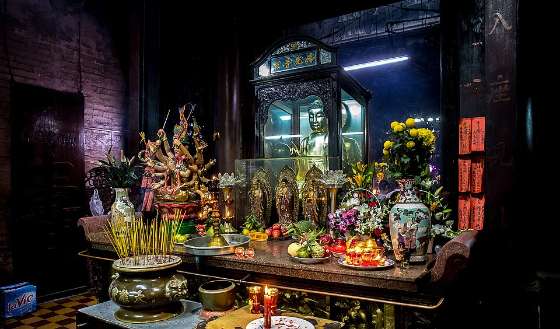
A century-old Chinese temple to the Jade Emperor in Tan Dinh, with yin-yang tiled roofs and vivid coloured ceramic figures
On Mai Thi Luu Street, Dien Ngoc Hoang, also known as the Jade Emperor Pagoda, Phuoc Hai Pagoda or Ngoc Hoang Dien, is one of old Saigon's famous ancient pagodas. It was founded by the Chinese master Luu Minh and inaugurated in 1906; it was later restored many times and renamed Phuoc Hai Pagoda. In 1994, it was classified as a National Architectural and Artistic Relic. The pagoda strongly reflects Chinese temple architecture: built of fired brick, roofed with yin-yang tiles, with ridges and roof corners decorated with many coloured ceramic figures; inside are numerous devotional paintings, statues, carved wooden screens and parallel sentences. The grounds are divided into three main halls: the Front Hall, Middle Hall and Main Hall. The supreme deity worshipped is the Jade Emperor; the pagoda also honours the Buddha, Bodhisattvas and many deities such as the Holy Mother Kim Hoa, Ong To and Ba Nguyet (the matchmaker deities) and the 12 Midwife Goddesses. In an old shrine beside the pagoda, a stone symbolising the Khmer "Ong Ta" is also worshipped. Many people come here to pray for love and for children. The Jade Emperor's festival day, the 9th day of the 1st lunar month, is the busiest time of the year for incense offerings. The pagoda is open 7:00 – 17:30; on the 1st and 15th of the lunar month it opens from 5:00 to 19:00. It is part of the city's "Sai Gon – Ve chon an nhien" (Saigon – Return to Serenity) itinerary.
English text: machine translation from the Localis platform — proper names kept in Vietnamese.Good to know
Best time to visitYear-round; busiest on the Jade Emperor's festival day (9th day of the 1st lunar month)
Services
- Pay respects at the Jade Emperor's altar
- Admire the coloured ceramic figures, carved wooden screens and old parallel sentences
- Combine with the "Sai Gon – Ve chon an nhien" itinerary














 Localis