
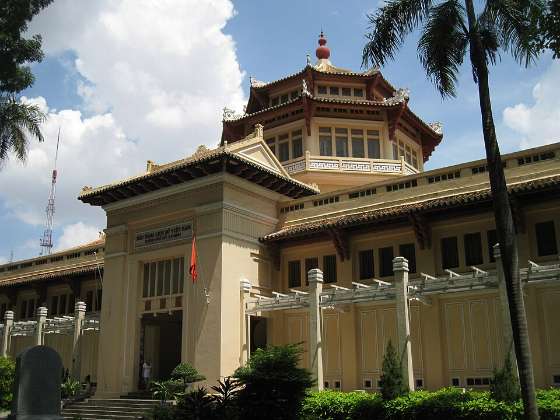
The oldest museum in Ho Chi Minh City, holding tens of thousands of artefacts on Vietnamese history and culture.
01. Origins and development This is the first museum in the southern region. The front building was designed by the French architect Auguste Delaval and inaugurated on 1 January 1929 under the name Blanchard de la Brosse Museum. In 1956 it was renamed the National Museum of Vietnam in Saigon, and it has borne its present name since 23 August 1979. The U-shaped building at the rear was designed by architect Nguyen Ba Lang and built in 1970. The complex follows the Indochinese architectural style, with an octagonal central hall and yin-yang tiled roofs, on grounds totalling 6,057 sq m; it was classified as a national-level architectural and artistic monument by the Ministry of Culture, Sports and Tourism in 2012. In October 2023 the museum was awarded Grade I status. 02. Collection & Displays The museum holds more than 40,000 artefacts, presented in 18 exhibition rooms. Eight of them retrace the history of Vietnam from the primitive era to the Nguyen dynasty, running from primitive times and the ages of founding and defending the country, through the Ngo - Dinh - Early Le, Ly, Tran - Ho, Early Le - Mac - Restored Le and Tay Son periods to the Nguyen dynasty. The remaining ten rooms are thematic: Champa culture, Oc Eo culture, Cambodian stone sculpture, the Duong Ha collection, ceramics from several Asian countries, the Xom Cai mummy, the Vuong Hong Sen collection, the cultures of the southern ethnic groups, Buddha statues from several Asian countries, and an outdoor area displaying 18th- and 19th-century cannons. 03. Highlights - 12 national treasures: the museum currently holds 12 national treasures, among them many outstanding sculptures of the Champa and Oc Eo cultures, such as the Dong Duong Buddha, the statue of the goddess Devi and the statue of the god Vishnu. - The Xom Cai mummy: discovered in 1994 in the Xom Cai area, it is one of the exhibits that draws particular attention from visitors and provides documentation on the burial techniques and treatment of the dead in former times. - The Vuong Hong Sen collection: 849 antiques donated by the scholar Vuong Hong Sen, reflecting part of the value of private antique collections in the southern region. - Indochinese architecture: the museum as a whole combines Western architecture with East Asian elements, standing out for its octagonal central hall and yin-yang tiled roofs. 04. Good to know - The Xom Cai mummy room has a distinctive subject matter, so visitors may wish to consider it beforehand if they are not used to this kind of exhibit. - The museum consists of many rooms one after another; it is best to follow the sequence of the rooms in order to keep track of the historical thread. - During the visit, please stay quiet and comply with the museum's rules, and in particular do not touch the exhibits. 05. Visitor information - Ticket price: 30,000 VND per person per visit. - School pupils and university students (with a card) and certain policy beneficiaries receive a 50% discount on the visit fee. Admission is free for children under 6 and certain other groups. - How to buy tickets: buy them directly at the museum's ticket counter.
English text: machine translation from the Localis platform — proper names kept in Vietnamese.Good to know
Best time to visitQuanh nam
Services
- QR-code audio guide app
- Guide booking
- Weekend water puppet performances














 Localis