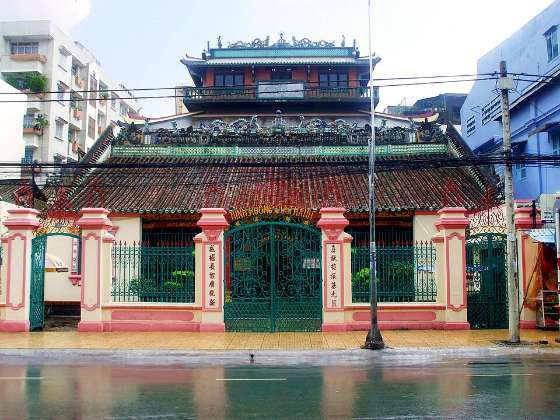
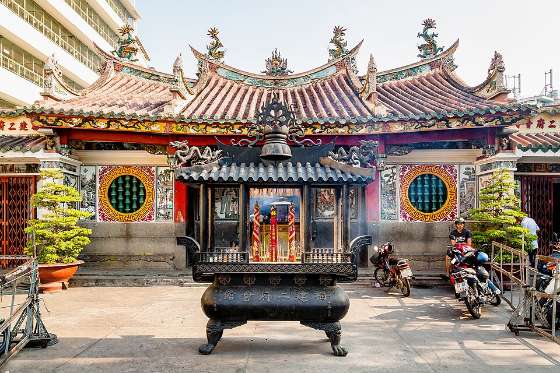
An assembly hall of the Minh Huong community in Cho Lon, preserving an 18th-century rear hall and a horizontal plaque bestowed by Emperor Tu Duc
On Tran Hung Dao Street in the heart of Cho Lon, Minh Huong Gia Thanh Communal House, also known as Minh Huong Assembly Hall, is one of the oldest communal houses in the city, bearing witness to the first waves of Chinese migrants who arrived in this new land. The Minh Huong community founded their village in 1698; the communal house is said to have been built in the Ky Dau year, 1789, in the De Ngan area. In 1993, it was classified as a National Architectural and Artistic Relic. The word "Huong" in its name carries two meanings: "huong" as village, where the Nguyen lords allowed the migrants to establish Minh Huong commune, and "huong" as incense, expressing the duty to keep the ancestral incense burning. The communal house worships four village deities: Ngu Tho, Ngu Coc, Dong Tru Tu Lenh and Bon Canh Thanh Hoang. Two altars on either side are dedicated to the founding forebears: on the civil side are Trinh Hoai Duc and Ngo Nhan Tinh, two of the "Gia Dinh tam gia" (Three Masters of Gia Dinh); on the military side are Le Thanh hau Nguyen Huu Canh and Tran Thuong Xuyen. Placing a Vietnamese general and a Chinese general on the same altar shows that the migrants honoured not only their own leader but also the Vietnamese who helped pioneer the land. The grounds are 50 m long and 30 m wide, comprising the vo ca (front hall), the main hall, a skylit courtyard and the rear hall, which retains its original 18th-century architecture. During the 1962 restoration, an upper floor was added to the main hall and coloured glass was fitted on the roof to let in light. The front hall holds 21 horizontal plaques arranged in five tiers, the most precious being "Thien Tuc Kha Phong" (good customs worthy of praise), bestowed by Emperor Tu Duc in the 17th year of his reign (1864). Many parallel sentences were carved from a single split log, with pairs of dragons in high relief rising 10 – 15 cm from the wood. Two steles erected in 1839 record the names of 29 people in Gia Dinh who passed examinations from Tu tai to Cu nhan level, along with notable Minh Huong figures. The biggest ceremony at the communal house is the Ky Yen festival on the 16th day of the 1st lunar month. The communal house is a stop on the "Ky uc Sai Gon – Cho Lon" (Memories of Saigon – Cho Lon) tour, together with Nghia An Assembly Hall and Hai Thuong Lan Ong traditional medicine street.
English text: machine translation from the Localis platform — proper names kept in Vietnamese.Good to know
Best time to visitYear-round; festive during the Ky Yen festival (16th day of the 1st lunar month)
Services
- Tour the front hall, main hall and 18th-century rear hall
- See the "Thien Tuc Kha Phong" plaque and parallel sentences carved with dragons in relief
- Attend the Ky Yen festival on the 16th day of the 1st lunar month
- Combine with the "Ky uc Sai Gon – Cho Lon" tour and Nghia An Assembly Hall















 Localis