


Arts & creative · Xuan Hoa
The Lab Saigon
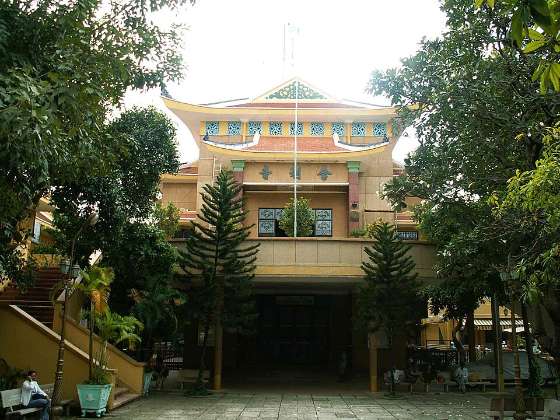
A pagoda enshrining relics of the Buddha in the former District 3, with a seven-storey bell tower 32 m tall
Xa Loi Pagoda, also known as Xa Loi Buddhist Studies Pagoda, was built by the Southern Vietnam Buddhist Studies Association to enshrine relics of the Buddha. Construction began in 1956 to a design by architects Tran Van Duong and Do Ba Vinh, and was completed on 2 May 1958. The architecture is modern yet distinctly traditional in character: a two-storey pagoda on a 2,500 m² plot, roofed with Western-style tiles, with a seven-storey, 32 m bell tower alongside. The main hall is 30 m long, 15 m wide and nearly 9 m high, and is dedicated solely to Shakyamuni Buddha: a 4 m gilded statue seated on a rectangular lotus throne 1.63 m high. Along both side walls are fourteen paintings illustrating the life of the Buddha, from his birth to his entry into Nirvana. In front of the altar, a spherical incense burner is held up by three rearing dragons, with four more dragon statues around it. The bell tower has a square plan with recessed corners, giving it an octagonal appearance, and stylised dragon motifs at the tips of the roof corners. The top level holds a great bell cast in 1961 in Duong Bieu village, Hue, modelled on the bell of Linh Mu Pagoda; it weighs 2 tonnes, measures 1.2 m in diameter and 1.6 m in height, and has a dragon-shaped handle. The pagoda holds many precious objects donated by Buddhist communities abroad: a golden stupa containing relics of the Buddha, brought over by the eminent Sri Lankan monk Narada Mahathera; a Pali scripture written on palm leaves more than a thousand years old, donated by the Sri Lankan Sangha; a red-bronze Buddha head donated by Pakistani Buddhists; and a bodhi tree planted in 1958, propagated from the original bodhi tree in Sri Lanka and also brought over by Narada Mahathera. The pagoda holds an important place in the history of Vietnamese Buddhism: it housed the editorial office of Tu Quang magazine of the Southern Vietnam Buddhist Studies Association, was the first lecture hall of the Saigon Higher Institute of Buddhist Studies (1964 – 1966), served as the headquarters of Central Office II of the Vietnam Buddhist Sangha from 1981 to 1993, and witnessed the process of unifying Vietnamese Buddhism. In 2005, it was designated a City-level Historical Relic.
English text: machine translation from the Localis platform — proper names kept in Vietnamese.Good to know
Best time to visitYear-round
Services
- Pay respects to the 4 m gilded statue of Shakyamuni Buddha
- See the fourteen paintings of the Buddha's life along the side walls
- Admire the 7-storey, 32 m bell tower and its great bell cast in Hue
- Find the bodhi tree planted in 1958 from Sri Lanka
















 Localis